
How Our Tanks Work
Understanding your 1500L septic tank — a self-contained wastewater treatment system designed for small dwellings. The same three-chamber design is also available in our 2500L tank for larger family homes.
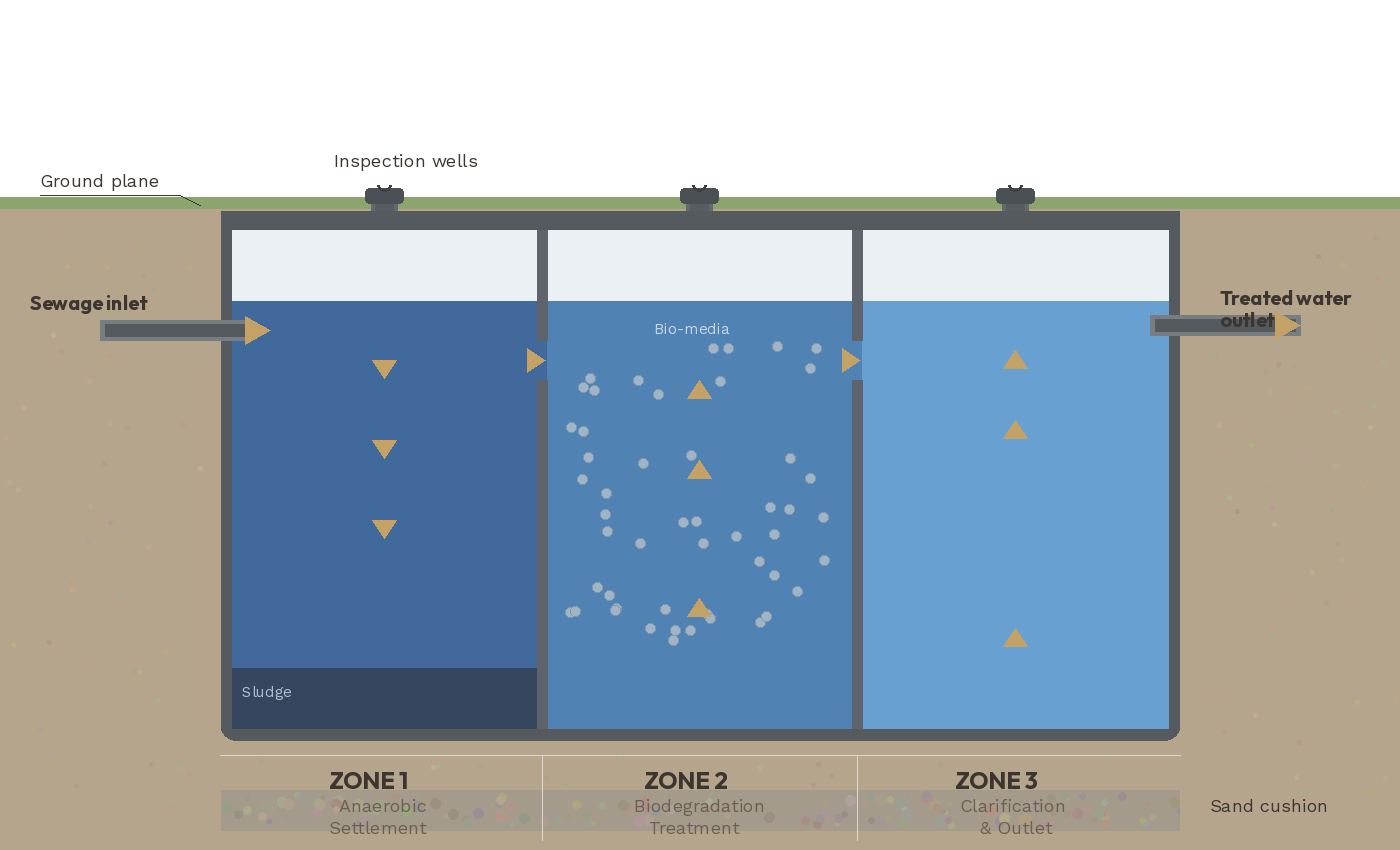
Cross-section of the Bush Billabongs 1500L multi-chamber septic tank
When wastewater enters the tank, it passes through three treatment zones that filter, settle, and biologically treat the waste before clean effluent exits for disposal via a drainage field.
See full specs and pricing on the 1500L septic tank product page, read the complete tiny home septic guide, our buyer's guide on how to choose the right septic tank, or contact us for a quote.
Three Treatment Zones
Zone 1: Primary Settlement
Wastewater enters the first chamber through the inlet pipe. Heavy solids sink to the bottom forming a sludge layer, while lighter materials like oils and grease float to the surface as scum. The liquid in between — called effluent — flows through to the next zone via an opening in the baffle wall. This initial separation is critical to the treatment process.
Zone 2: Biological Treatment
In the second chamber, naturally occurring bacteria break down the remaining organic matter in the effluent. This anaerobic and aerobic digestion process significantly reduces the biological load of the wastewater. The longer the effluent stays in this zone, the more thoroughly the bacteria can do their work.
Zone 3: Clarification & Outlet
The final chamber allows any remaining fine particles to settle out. The clarified water — now significantly cleaner than when it entered — exits through the outlet pipe. This treated effluent then flows to your drainage field or absorption trench, where it is safely filtered back into the surrounding soil.
Specifications
- Capacity
- 1,500 litres
- Weight
- 61 kg
- Length
- 2,030 mm
- Width
- 1,110 mm
- Height
- 1,120 mm
- Wall Thickness
- 5 mm
- Hole Dimensions
- 315 × 200 × 200 mm
- Material
- Ribbed polyethylene
- Chambers
- 3 (anaerobic, decay, clarification)
- Suitable For
- 1–4 bedroom small dwellings
- Applications
- Tiny homes, cabins, granny flats, sheds, off-grid builds
- Price
- From $949 AUD excl. GST
Basic Maintenance Guide
Pump out every 3–5 years
A licensed waste removal contractor should pump out accumulated sludge. Frequency depends on household size and water usage.
Avoid harsh chemicals
Bleach, antibacterial cleaners, and chemical drain openers kill the beneficial bacteria that break down waste inside the tank.
Watch what goes in
Never flush nappies, wipes, sanitary products, cooking oil, paint, or medications. These block the system and disrupt treatment.
Inspect annually
Check inlet and outlet pipes, inspect for odours or wet patches near the drainage field, and monitor scum and sludge levels.
Protect the drainage field
Don't park vehicles or build structures over the absorption trench. Keep tree roots away from the drainage area.
The Three-Chamber Process — Step by Step
Chamber 1 — Primary Settlement
Wastewater enters through the inlet pipe with a T-baffle that directs flow downward to prevent disturbing the surface. Heavy solids (faeces, food particles, paper) sink to form the sludge layer at the bottom. Lighter materials (fats, oils, grease) float to form the scum layer at the top. The clarified liquid between — the effluent — begins moving toward chamber 2. The first chamber holds approximately 50–55% of the tank's total volume, giving solids maximum time to settle.
Chamber 2 — Anaerobic Digestion
The effluent passes through a submerged port at the base of the dividing wall into the second chamber, leaving most solids behind. Anaerobic bacteria (those that thrive without oxygen) break down the organic matter remaining in the liquid. This process significantly reduces the biological oxygen demand (BOD) of the effluent. The second chamber holds approximately 30% of the tank's volume and is where the most significant biological treatment occurs.
Chamber 3 — Clarification and Outlet
The partially treated effluent moves into the final chamber for a final period of settlement. Any remaining fine suspended solids settle here. The clarified liquid exits through an outlet T-baffle — positioned below the surface to prevent scum from escaping — and flows by gravity into the absorption trench for final treatment in the soil.
INLET → [Chamber 1: Settlement] → [Chamber 2: Digestion] → [Chamber 3: Clarification] → OUTLET → Absorption trench
See how this design suits a small dwelling in our complete tiny home septic guide.
Why Three Chambers Outperform Single-Chamber Tanks
Older single-chamber septic tanks treat the entire wastewater volume in one space. Without a physical barrier between fresh inflow and the outlet, every flush can stir up settled solids and push them straight out into the absorption trench. The result: trenches clog faster, soil pores blind off with biofilm, and the system needs pump-out every 1–2 years to keep working. Replacement of a clogged absorption trench can run $3,000–$8,000.
A three-chamber tank assigns each chamber a specific function. Chamber 1 captures the bulk of the solids. Chamber 2 lets anaerobic bacteria break down the organic load in calm, undisturbed conditions. Chamber 3 acts as a polishing chamber, settling any final fines before the effluent leaves the tank. By the time clarified liquid reaches the absorption trench, it's free of suspended solids and dramatically lower in BOD — which is exactly what the soil biofilter needs to work properly for decades.
Practical impact: pump-out only every 3–5 years for a typical household, and absorption trenches that routinely last 20–30 years rather than a single decade. Three-chamber design is now the standard for Australian residential wastewater treatment, used in every quality polyethylene tank on the market.
What Happens to the Sludge?
Sludge accumulates in chamber 1 over time as solids settle out of incoming wastewater. Anaerobic bacteria living in the tank do most of the heavy lifting, breaking down approximately 50–70% of solids into liquid and gas. The remaining residue — a stable, mineralised slurry — slowly builds up on the floor of the chamber.
Every 3–5 years, that accumulated sludge needs to be pumped out by a licensed liquid waste contractor. A vacuum truck connects to the tank through the inspection lids and removes sludge from all three chambers, returning the tank to working capacity. Pump-out cost is typically $300–$600 depending on your location and the volume removed.
The trigger for pump-out is straightforward: when the sludge layer in chamber 1 reaches within 300 mm of the outlet port, it's time. A licensed plumber or contractor can measure the sludge depth during an annual inspection. For a typical 1–2 person household using a 1500L tank, the 4–5 year cycle is normal.
Tank Specifications
- Capacity
- 1500 litres
- Weight (empty)
- 61 kg
- Dimensions (L × W × D)
- 2030 × 1110 × 1120 mm
- Wall thickness
- 5 mm polyethylene (HDPE)
- Inlet/outlet hole dimensions
- 315 × 200 × 200 mm
- Chambers
- Three (primary settlement, digestion, clarification)
- Inspection lids
- Three (one per chamber)
- Service life
- 30–50+ years in typical Australian conditions
Full pricing and ordering on the 1500L septic tank product page.
Maintenance Requirements
A three-chamber polyethylene septic tank is one of the simplest pieces of infrastructure on a rural property. No electricity is required — the entire system runs on gravity from inlet to absorption trench. There are no moving parts, no pumps, no aerators, no consumable parts and nothing that can mechanically fail.
An annual inspection is recommended. Check that the inlet and outlet baffles are clear of blockage, confirm the lids are sealed, and check for any unusual odours that might indicate a venting or seal issue. A licensed plumber can do this as part of a standard service visit.
Pump-out every 3–5 years by a licensed liquid waste contractor — more frequently for larger households or higher water-use homes. See how to choose a tank for the full sizing guide.
Do not dispose of: non-biodegradable wipes (including "flushable" wipes), sanitary products, cooking oils and fats, harsh chemical cleaners, bleach in significant quantities, or medications. These items either disrupt the bacterial process or accumulate as sludge that the bacteria cannot break down.
Do not plant deep-rooted trees within 3 metres of the tank or the absorption trench. Roots can damage the tank, baffles and trench pipework.
Frequently Asked Questions
How does a three-chamber septic tank work?
A three-chamber septic tank separates wastewater treatment into three stages: settlement (chamber 1), where solids sink and float; anaerobic digestion (chamber 2), where bacteria break down organic matter in the liquid; and clarification (chamber 3), where remaining fine particles settle before the clarified effluent flows to the absorption trench. Each chamber is separated by a submerged port that allows only clarified liquid to pass through while retaining solids.
How long does a 1500L septic tank last?
A high-quality polyethylene septic tank has a service life of 30–50+ years under normal Australian conditions. Unlike concrete, polyethylene doesn't crack from ground movement or corrode from soil chemistry. The main maintenance requirements are pump-out every 3–5 years and occasional inspection of inlet and outlet baffles.
What bacteria live in a septic tank?
Anaerobic bacteria (those that function without oxygen) do most of the treatment work inside a septic tank. These naturally occurring bacteria break down organic waste in the effluent. They thrive at normal temperatures and require no management. Avoid pouring antibacterial cleaners, bleach, or disinfectants into drains in large quantities, as these can disrupt the bacterial colony.
Can I use normal toilet paper in a septic system?
Yes — standard toilet paper breaks down readily in a septic system. Avoid "flushable" wipes, wet wipes, paper towels, and sanitary products, which do not break down and accumulate as sludge, shortening the time between pump-outs significantly.
How do I know when my septic tank needs pumping out?
Signs include slow-draining fixtures, gurgling drains, sewage odours near the tank or absorption trench, or wet patches above the absorption trench. A licensed plumber can also measure the sludge depth during an inspection. For most 1–2 person households using a 1500L tank, pump-out is typically required every 4–5 years.
What is the difference between a septic tank and an AWTS?
A septic tank is a passive system — no electricity, no moving parts, low maintenance. An Aerated Wastewater Treatment System (AWTS) uses electric pumps and aeration to produce higher-quality effluent but costs $5,000–$15,000 and requires quarterly professional servicing. For most small residential builds with suitable soil, a septic tank is the simpler and more affordable option.
Have more questions? Contact our team — typical response within an hour.